

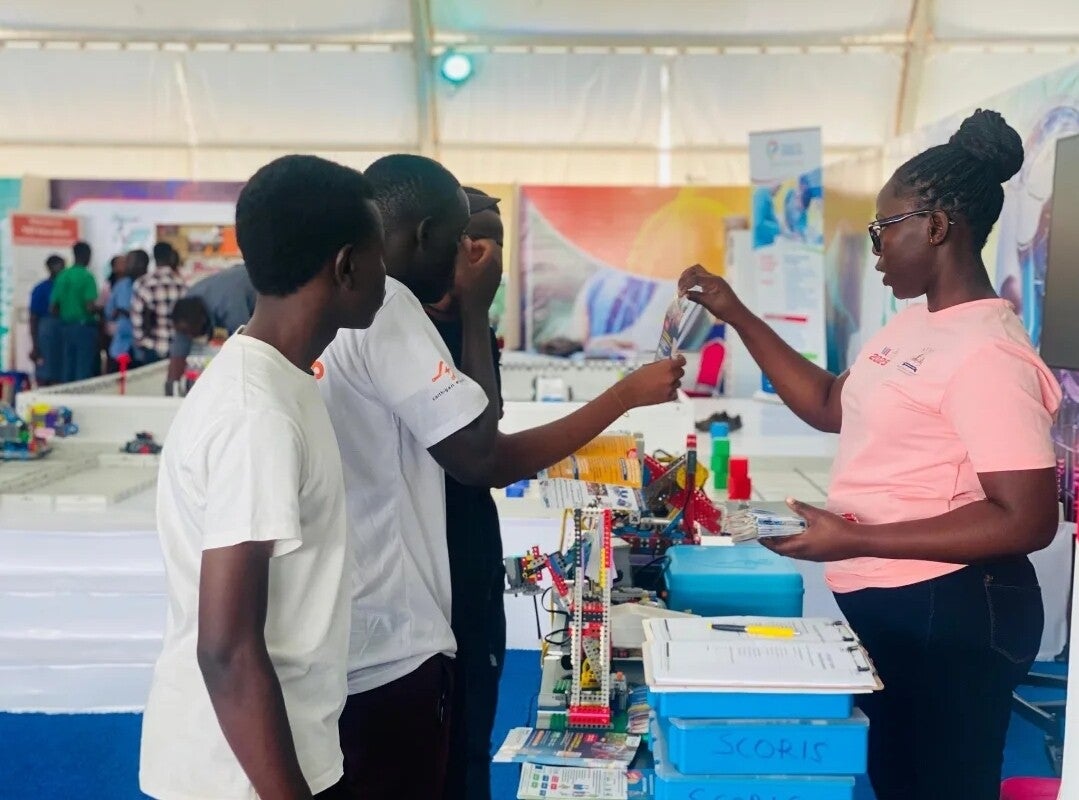
Robotics coding camp
A transformative SGEP education program for rural students
SGEP runs this project in different schools, teaching young people emerging science and technology skills including how to code with robots.
SGEP provides opportunities to rural students to explore coding and robotics, discover their strengths and consider taking up STEM education and career pathways. SGEP continues to hold these camps, drawing on our funding support as well as the passionate contributions of their amazing educator team.
As well as purchasing a range of coding robots for students at different stages of development, the funds support professional development for rural teachers to deliver effective STEM instruction to ensure the camp’s success.
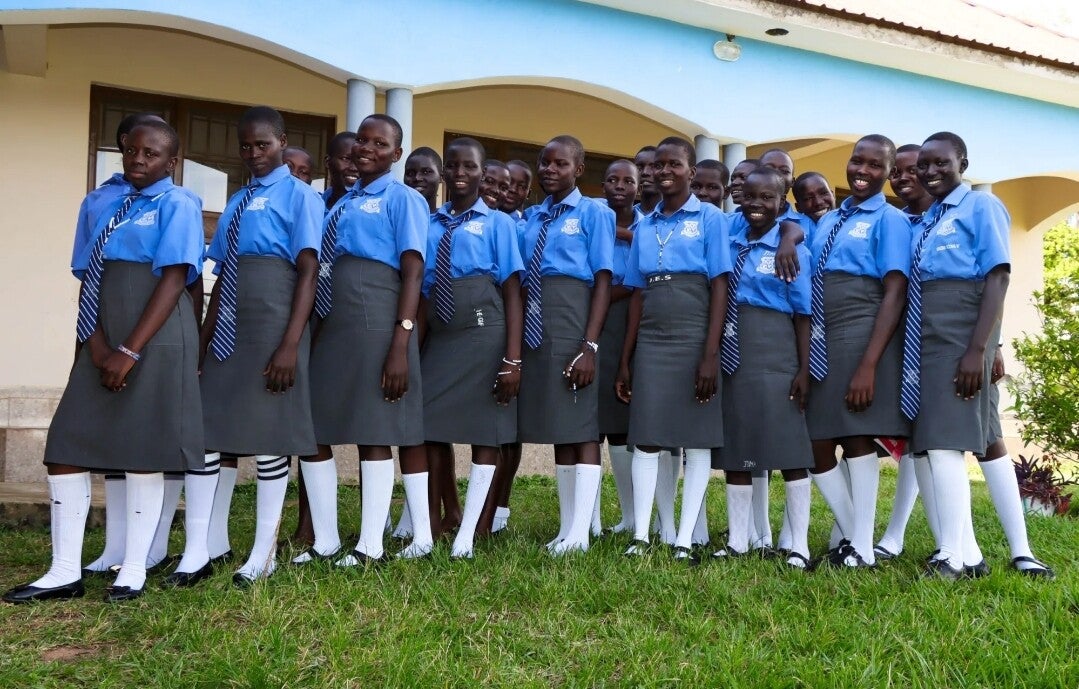
High school scholarships for rural Ugandan girls
These sponsorships cover tuition, texbooks, calculators, geometrical sets, uniforms and sanitary products for girls from low-income rural families to support their education.
Since 2017, SGEP Uganda has provided sponsored students from rural, low-income, marginalised families. The scholarships cover tuition, textbooks, calculators, geometrical sets, uniforms, shoes and sanitary pads for their first year of high school. These resources enable each girl to transition successfully to high school and build self-confidence in her ability to advance to the next phase of her education. We also ensure the schools they attend have all facilities to provide contemporary education in science, technology, engineering, arts and mathematics.
Wheels for Education
Since 2021, this project has delivered 51 bicycles to help rural girls in Luwero, Nakaseke, Mukono and Mubende districts, so as to facilitate goig to school and promote performance of science and mathemtics.

SGEP Uganda promotes STEM in schools
We deliver quality science, technology, engineering and mathematics education. This project serves students from rural, low-income families to discover their passions and potential in STEM careers.
We transition schools into providers of science, technology, engineering and mathematics (STEM) learning opportunities and career inspiration for secondary-school students empowering them to embrace STEM subjects, tackle complex social and technological challenges, and pursue high-value careers. We deliver a range of high impact co-curricular programs, such as leadership and mentoring programs, STEM camps, career talks and exhibitions, and sustainable food programs. Students take part in competitions such as the Climate Solutions Campaign, Technovation Challenge and School Enterprise Challenge where students identify challenges in their communities and design innovative solutions using technology they have learnt at the Academy. It is also investing in teacher professional development, to build capacity of rural teachers to deliver quality STEM instruction.

STEM & partnerships
SGEP Engaged the Ministry of Education which initiated a dialogue on the STEM/ICT project and policy review. The meeting discussed and agreed that the STEM policy is combined with the ICT Policy to be STEM/ICT Policy. The discussion is still underway to ensure the realization of the STEM National Policy. Trained and capacity built 201 teachers and 714 youth (both directly and indirectly) on Digital skills and artificial intelligence. This aided in building the capacity of the students.
In working with the schools, 3100 girls and 620 boys were trained on Coding/Artificial Intelligence. STEM clubs were established in the new participating schools and strengthened to enhance the participation of girls. Through these club’s students were able to get resources such as mentors, online reading materials and exchange visits which aimed at building their capacity. It also involved peer to peer education in other areas where students would seek guidance. Developed active partnerships with like-minded partners within the region: The MoE, CBOs, NGOs and other entities.

Adolescent Sexual Reproductive Health Programme
The Adolescent Sexual and Reproductive Health and Right Project has been Implemented in 48 schools and surrounding in 5 rural districts.
Due to the positive impact realized through the program, it was scaled up to cover 27 schools and surrounding communities (2018-2022). After Covid19, the project focused on communication and national advocacy on Adolescent Sexual and Reproductive Health and Rights Policy and integration into the School Curriculum. It also covered bursaries for the needy, provision of menstrual products (sanitary towels) to girls, mentorship, guidance and counselling and teenage mother readmission. The outcome is to eradicate child pregnancies, complications arising from unsafe abortions and childbirth, Tackle Female Genital Mutilation, sexual violence against girls, including rape, defilement and sexual harassment, besides enhancing knowledge about HIV/AIDS and other STDs. The local health centres were linked to the schools to make it easy for the girls to get more information on sexuality and assistance when it comes to their protection.

Rise up girls project
The project aims to reduce gender-based barriers for adolescent girls’ education and skill development in Uganda
Expected Outcomes
- Government Policies and Plans Implemented to Reduce Gender-Based Barriers to Adolescent and Young Girls’
- Strengthened gender-responsive safe learning
- Increased Community-Level Actions to dismantle harmful gender norms and barriers to girls’ education;

Project interventions
- Support review and completion of the Draft of the Education and Training Gender Policy, and the National Education Sector Strategic Plan (2023-2027)
- Conduct research on the specific gender-based barriers that hinder girls’ education in the country (particularly, the research will try to establish barriers to the enactment and implementation of policies meant to reduce gender-based barriers to girls’ education in Kenya, and why there is no or little concerted effort to end barriers to girls’ education despite the existing policies and laws).
- Support the government to disseminate key policies, such as the Re-entry Policy of 2020, Guidance and Counseling Policy 2023, Mentorship Policy 2018 to 5 select Counties and Schools.
- Support initiatives that enhance the capacity of teachers and educators to provide gender-responsive and inclusive environments in 15 secondary institutions across the 5 counties.
- Provide secondary-level bursaries to 30 vulnerable girls who are at risk of dropping out of school due to Gender-based violence including child marriage, teenage pregnancies, and FGM.
- Support FAWE-K journalists’ network to write compelling narratives and stories that highlight the importance of girls’ education and showcase successful examples of girls who have overcome barriers.

Mathematics Projects in schools
We implement Mathematics Projects in schools to make student have Passion for Mathematics, which is a compulsory subject in Ugandan secondary education. During these projects, we establish libraries, stock them with mathematics books, we train teachers, we establish student trips. SGEP Uganda also provides calculators, geometrical sets to facilitate Mathematics education. Project Selection: Teachers select accessible mathematical problems rooted in local realities (e.g., agriculture, market trading, or community health).
Planning: Students work collaboratively to design an investigation strategy, defining what data to collect and which mathematical tools to use.
Execution: Students gather real-world data and apply mathematical models (such as statistics, geometry, or algebraic equations) to find solutions.
Evaluation: Peers and teachers assess the mathematical accuracy, logical reasoning, and practical utility of the project outcomes.
Reporting & Recording: Students document their findings using low-cost materials (e.g., posters, oral presentations) to share with the class or school community.
Barriers to these projects
Lack of internet, digital tools, and standard textbooks.
Rigid school timetables focused heavily on memorization for national tests.
Teachers trained primarily via lecture-based methods may lack experience in open-ended facilitation.
Instructing in national or foreign languages, English rather than local mother tongues.
Our mitigation strategies
Rely on physical modeling, paper charts, and local environmental data.
Align project objectives directly with compulsory exam topics (e.g., geometry or statistics).
Introduce peer-support networks and regional professional development programs.
Utilize visual media, physical objects, and peer translation during group work.